Palm Sunday - April 13, 2014
Holy Day of Obligation

Entry of Christ into Jerusalem (1320) by Pietro Lorenzetti: entering the city on a donkey symbolizes arrival in peace rather than as a war-waging king arriving on a horse[1][2]
In many Christian churches, Palm Sunday includes a procession of the assembled worshipers carrying palms, representing the palm branches the crowd scattered in front of Jesus as he rode into Jerusalem. The difficulty of procuring palms in unfavorable climates led to their substitution with branches of native trees, including box, yew, willow, and olive. The Sunday was often designated by the names of these trees, as in Yew Sunday, or by the general term Branch Sunday.
Contents
- 1 Biblical basis and symbolism
- 2 Observance in the liturgy
- 2.1 Eastern and Oriental Christianity
- 2.2 Western Christianity
- 3 Customs
- 3.1 Belgium
- 3.2 Bulgaria
- 3.3 Finland
- 3.4 India
- 3.5 Italy
- 3.6 Latvia
- 3.7 Lithuania
- 3.8 Malta
- 3.9 The Levant
- 3.10 Netherlands
- 3.11 Philippines
- 3.12 Poland
- 3.13 Romania and Moldova
- 3.14 Spain
- 4 See also
- 5 Notes
- 6 References
- 7 External links
Biblical basis and symbolism[edit]
Main article: Triumphal entry into Jerusalem

Triumphal entry into Jerusalem, fresco in the Parish Church Zirl, Austria
The symbolism is captured in Zechariah 9:9 "The Coming of Zion's King – See, your king comes to you, righteous and victorious, lowly and riding on a donkey, on a colt, the foal of a donkey". It was perceived that Jesus was declaring he was the King of Israel to the anger of the Sanhedrin.
According to the Gospels, Jesus rode a donkey into Jerusalem, and the celebrating people there laid down their cloaks in front of him, and also laid down small branches of trees. The people sang part of Psalm 118: 25–26 – ... Blessed is He who comes in the name of the Lord. We bless you from the house of the Lord ....[2][4][5][6]
The symbolism of the donkey may refer to the Eastern tradition that it is an animal of peace, versus the horse, which is the animal of war.[1] A king came riding upon a horse when he was bent on war and rode upon a donkey when he wanted to point out he was coming in peace. Jesus' entry to Jerusalem would thus symbolize his entry as the Prince of Peace, not as a war-waging king.[1][2]

“Flevit super illam” (He wept over it); by Enrique Simonet, 1892.
In many lands in the ancient Near East, it was customary to cover in some way the path of someone thought worthy of the highest honour. The Hebrew Bible (2 Kings 9:13) reports that Jehu, son of Jehoshaphat, was treated this way. Both the Synoptic Gospels and the Gospel of John report that people gave Jesus this form of honour. However, in the synoptics they are only reported as laying their garments and cut rushes on the street, whereas John specifies fronds of palm (Greek phoinix). In Jewish tradition, the palm is one of the Four Species carried for Sukkot, as prescribed for rejoicing at Leviticus 23:40.
The palm branch was a symbol of triumph and victory in the Greco-Roman culture of the Roman Empire, and became the most common attribute of the goddess Nike or Victory.[9] For contemporary Roman observers, the procession would have evoked the Roman triumph,[10] when the triumphator laid down his arms and wore the toga, the civilian garment of peace that might be ornamented with emblems of the palm.[11] Although the Epistles of Paul refer to Jesus as "triumphing", the entry into Jerusalem may not have been regularly pictured as a triumphal procession in this sense before the 13th century.[12] In ancient Egyptian religion, the palm was carried in funeral processions and represented eternal life. The palm branch later became a symbol of Christian martyrs and their spiritual victory or triumph over death.[13] In Revelation 7:9, the white-clad multitude stand before the throne and Lamb holding palm branches.
In the 16th and 17th centuries, Palm Sunday was marked by the burning of Jack-'o'-Lent figures. This was a straw effigy which would be stoned and abused. Its burning on Palm Sunday was often supposed to be a kind of revenge on Judas Iscariot, who had betrayed Christ. It could also have represented the hated figure of Winter whose destruction prepares the way for Spring.[14]
Observance in the liturgy[edit]

The congregation in an Oriental Orthodox church in India collects palm fronds for the Palm Sunday procession
(the men of the congregation on the left of the sanctuary in the photo;
the women of the congregation are collecting their fronds on the right
of the sanctuary, outside the photo.
Eastern and Oriental Christianity[edit]
Palm Sunday, or the "Entry of the Lord into Jerusalem," as it is often called in some Orthodox Churches, is one of the Twelve Great Feasts of the liturgical year. The day before Palm Sunday, Lazarus Saturday, believers often prepare palm fronds by knotting them into crosses in preparation for the procession on Sunday. The hangings and vestments in the church are changed to a festive color - gold in the Greek tradition and green in the Slavic tradition.The Troparion of the Feast indicates the resurrection of Lazarus is a prefiguration of Jesus' own Resurrection:
- O Christ our God
- When Thou didst raise Lazarus from the dead before Thy Passion,
- Thou didst confirm the resurrection of the universe.
- Wherefore, we like children,
- carry the banner of triumph and victory,
- and we cry to Thee, O Conqueror of love,
- Hosanna in the highest!
- Blessed is He that cometh
- in the Name of the Lord.

Palm Sunday procession, Moscow, with Tsar Alexei Michaelovich (painting by Vyacheslav Gregorievich Schwarz, 1865)

Palm Sunday in Moscow, 1654.
Caption on the illustration: Abrieß der Muscowitischen Prozession am Palmsontag
Caption on the illustration: Abrieß der Muscowitischen Prozession am Palmsontag
In Russia, donkey walk processions took place in different cities, but most importantly in Novgorod and, since 1558 until 1693, in Moscow. It was prominently featured in testimonies by foreign witnesses and mentioned in contemporary Western maps of the city. The Patriarch of Moscow, representing Christ, rode on a "donkey" (actually a horse draped in white cloth); the Tsar of Russia humbly led the procession on foot. Originally, Moscow processions began inside the Kremlin and terminated at Trinity Church, now known as Saint Basil's Cathedral, but in 1658 Patriarch Nikon reversed the order of procession. Peter I, as a part of his nationalisation of the church, terminated the custom; it has been occasionally recreated in the 21st century.
In Oriental Orthodox churches, palm fronds are distributed at the front of the church at the sanctuary steps, in India the sanctuary itself having been strewn with marigolds, and the congregation proceeds through and outside the church.
Western Christianity[edit]
In ancient times, palm branches symbolized goodness and victory. They were often depicted on coins and important buildings. Solomon had palm branches carved into the walls and doors of the temple (1 Kings 6:29). Again at the end of the Bible, people from every nation raise palm branches to honor Jesus (Revelation 7:9).Palm Sunday commemorates the entrance of Jesus into Jerusalem (Matthew 21:1-9), when palm branches were placed in his path, before his arrest on Holy Thursday and his crucifixion on Good Friday. It thus marks the beginning of Holy Week, the final week of Lent.
In the Roman Catholic Church, as well as among many Anglican and Lutheran congregations, palm fronds (or in colder climates some kind of substitutes) are blessed with an aspergillum outside the church building (or in cold climates in the narthex when Easter falls early in the year). A solemn procession also takes place. It may include the normal liturgical procession of clergy and acolytes, the parish choir, or the entire congregation.
In the Catholic Church, this feast now coincides with that of Passion Sunday, which is the focus of the Mass which follows the service of the blessing of palms.

Blessing of palms outside an Episcopal Church in the United States.
In the Episcopal and many other Anglican churches and in Lutheran churches, as well, the day is nowadays officially called "The Sunday of the Passion: Palm Sunday"; in practice, though, it is usually termed "Palm Sunday" as in the 1928 American Book of Common Prayer and in earlier Lutheran liturgies and calendars, to avoid undue confusion with the penultimate Sunday of Lent in the traditional calendar, which was "Passion Sunday".
In the Church of Pakistan (a member of the Anglican Communion) on Palm Sunday, the faithful carry palm branches into the church, as they sing Psalm 24.
In many Protestant churches, children are given palms, and then walk in procession around the inside of the church while the adults remain seated.[citation needed]
Customs[edit]
It is customary in many churches for the worshippers to receive fresh palm leaves on Palm Sunday. In parts of the world where this has historically been impractical, substitute traditions have arisen.Belgium[edit]
In Hoegaarden one of the last remaining Palm Sunday processions take place every year. A fellowship of Twelve Apostles carries a wooden statue of Christ around the town, while children go door to door offering the palms (box) for coins.Bulgaria[edit]
In Bulgaria, Palm Sunday is known as Tsvetnitsa (tsvete is flower) or Vrabnitsa (varba is willow). People with flower-related names, (for example Tsvetelina, Tsvetelin, Tsvetana, Tsvetan, Tsvetko, Margarita, Ralitsa, Lilia, Violeta, Yavor, Zdravko, Zjumbjul, Nevena, Temenuzhka, Rosa etc.) celebrate this day as their name day.Finland[edit]
In Finland, it is popular for children to dress up as Easter witches and go door to door in neighborhoods for coins and candy. It is an old Karelian custom called Virpominen.India[edit]

Flowers (in this instance marigolds) strewn about the sanctuary in an Oriental Orthodox church in Mumbai, India on Palm Sunday
Italy[edit]
In Italy palm leaves are used along with small olive branches, readily available in the Mediterranean climate. These are placed at the entrance of houses (for instance, hanging above the door) to last until the following year's Palm Sunday. For this reason, usually palm leaves are not used whole, due to their size; instead, leave stripes are braided into smaller shapes. Small olive branches are also often used to decorate traditional Easter cakes, along with other symbols of birth, like eggs.Latvia[edit]
In Latvia, Palm Sunday is called "Pussy Willow Sunday", and pussy willows – symbolizing new life – are blessed and distributed to the faithful.[16] Children are often woken that morning with ritualistic swats of a willow branch.Lithuania[edit]
When Christianity came to Lithuania, plants which sprouted earliest were honored during spring feasts. the name "Palm Sunday", is a misnomer, the "verba" or "dwarfed spuce" is used instead. According to tradition, on the Saturday before Palm Sunday the Lithuanians take special care in choosing and cutting well-formed branches, which the women-folk decorate with flowers. They flowers are meticulously tied onto the branch, making the "Verba". Palm Sunday and Kaziuko mugė are celebrated together.Malta[edit]
All the parishes of Malta and Gozo on Palm Sunday (in Maltese Ħadd il-Palm) bless the palm leaves and the olive leaves. Those parishes that have the statues of Good Friday bless the olive tree they put on the statues of "Jesus prays in the Olive Garden" (Ġesù fl-Ort) and the "Betrayal of Judas" (il-Bewsa ta' Ġuda). Also, many people take a small branch of olive to their homes because it is a sacramental.The Levant[edit]
In Israel, Jordan, Lebanon, Palestine and Syria, Palm Sunday – known as Shaa'nineh in Arabic- is perhaps the best-attended service in the Christian Calendar, among the Orthodox, Catholic (Latin Church and Eastern Catholic Churches), and Anglican Churches, perhaps because it is notably a family occasion. On this day, children attend church with branches from olive and palm trees. Also, there will be carefully woven crosses and other symbols made from palm fronds and roses. There will normally be a procession at the beginning of the service and at some point, the priest will take an olive branch and splash holy water on the faithful.Netherlands[edit]
In the Saxon regions of the Netherlands, crosses are decorated with candy and bread, made in the form of a rooster. In the diocese of Groningen-Leeuwarden, a great procession with oil lamps is held the night before Palm Sunday in honour of the Sorrowful Mother of Warfhuizen.Philippines[edit]
Main article: Holy Week in the Philippines
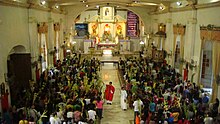
A priest blesses palm fronds in Plaridel, Bulacan.
Once blessed, the palaspas are taken home by the faithful and placed on altars, or hung beside, on, or above doorways and windows. Although the true purpose of this custom is to welcome Christ, many Filipinos hold the fronds to be apotropaic, able to banish evil spirits, avert lightning, and prevent fires. There is also a folk tradition of feeding pieces of the palm leaves to roosters for sabong (cockfighting), a practise that was strongly discouraged by the Archbishop of Manila, Luis Antonio Tagle.
Poland[edit]

A palm in Łyse, Poland.
Romania and Moldova[edit]
In Romania and Moldova, Palm Sunday is known as Duminica Floriilor or simply Florii, translating Flowers' Sunday.Spain[edit]
See also: Holy Week in Spain
In Elche, Spain, the location of the biggest palm grove in Europe,
there is a tradition of tying and covering palm leaves to whiten them
away from sunlight and then drying and braiding them in elaborate
shapes.A Spanish rhyming proverb states: Domingo de Ramos, quien no estrena algo, se le caen las manos ("On Palm Sunday, the hands drop off of those who fail to wear something new")
See also[edit]
- Crucifixion eclipse
- Palm branch (symbol)
Notes[edit]
- ^ a b c Matthew 19–28 by William David Davies, Dale C. Allison 2004 ISBN 0-567-08375-6 page 120
- ^ a b c John 12–21 by John MacArthur 2008 ISBN 978-0-8024-0824-2 pages 17–18
- ^ Mark 11:1–11, Matthew 21:1–11, Luke 19:28–44, and John 12:12–19.
- ^ a b The people's New Testament commentary by M. Eugene Boring, Fred B. Craddock 2004 ISBN 0-664-22754-6 pages 256–258
- ^ a b The Bible Knowledge Background Commentary: Matthew–Luke, Volume 1 by Craig A. Evans 2003 ISBN 0-7814-3868-3 page 381-395
- ^ a b The Synoptics: Matthew, Mark, Luke by Ján Majerník, Joseph Ponessa, Laurie Watson Manhardt 2005 ISBN 1-931018-31-6 pages 133–134
- ^ The Bible knowledge background commentary: John's Gospel, Hebrews–Revelation by Craig A. Evans ISBN 0-7814-4228-1 pages 114–118
- ^ Matthew 21:1–11, Mark 11:1–11, Luke 19:28–44 John 12:12–19
- ^ Reidar Hvalvik, "Christ Proclaiming His Law to the Apostles: The Traditio Legis-Motif in Early Christian Art and Literature," in The New Testament and Early Christian Literature in Greco-Roman Context: Studies in Honor of David E. Aune (Brill, 2006), p. 432; Guillermo Galán Vioque, Martial, Book VII: A Commentary, translated by J.J. Zoltowski (Brill 2002), pp. 61, 206, 411; Anna Clark, Divine Qualities: Cult and Community in Republican Rome (Oxford University Press, 2007), p. 162.
- ^ Warren W. Wiersbe, The Wiersbe Bible Commentary (David C. Cook, 2007), p. 272.
- ^ Vioque, Martial, Book VII: A Commentary, p. 61.
- ^ John Pairman Brown, Israel and Hellas (De Gruyter, 2000), vol. 2, p. 254ff.
- ^ Fernando Lanzi and Gioia Lanzi, Saints and Their Symbols: Recognizing Saints in Art and in Popular Images (Liturgical Press, 2004), p. 25.
- ^ Frood & Graves p.10
- ^ "NATIONAL / KERALA : Traditional services mark Palm Sunday". The Hindu. 2011-04-18. Retrieved 2012-06-10.
- ^ [1][dead link]
References[edit]
- Frood, J.D. & Graves, M.A.R. Seasons and Ceremonies: Tudor-Stuart England. Elizabethan Promotions, 1992
- Palm Sunday
- White palms for Sunday palm
- An Order of Service for Palm Sunday
- Learn how to make a cross out of palms
- Palm Sunday (Greek Orthodox Archdiocese of Australia)
- Palm Sunday according to the Byzantine Rite Tradition

No comments:
Post a Comment